
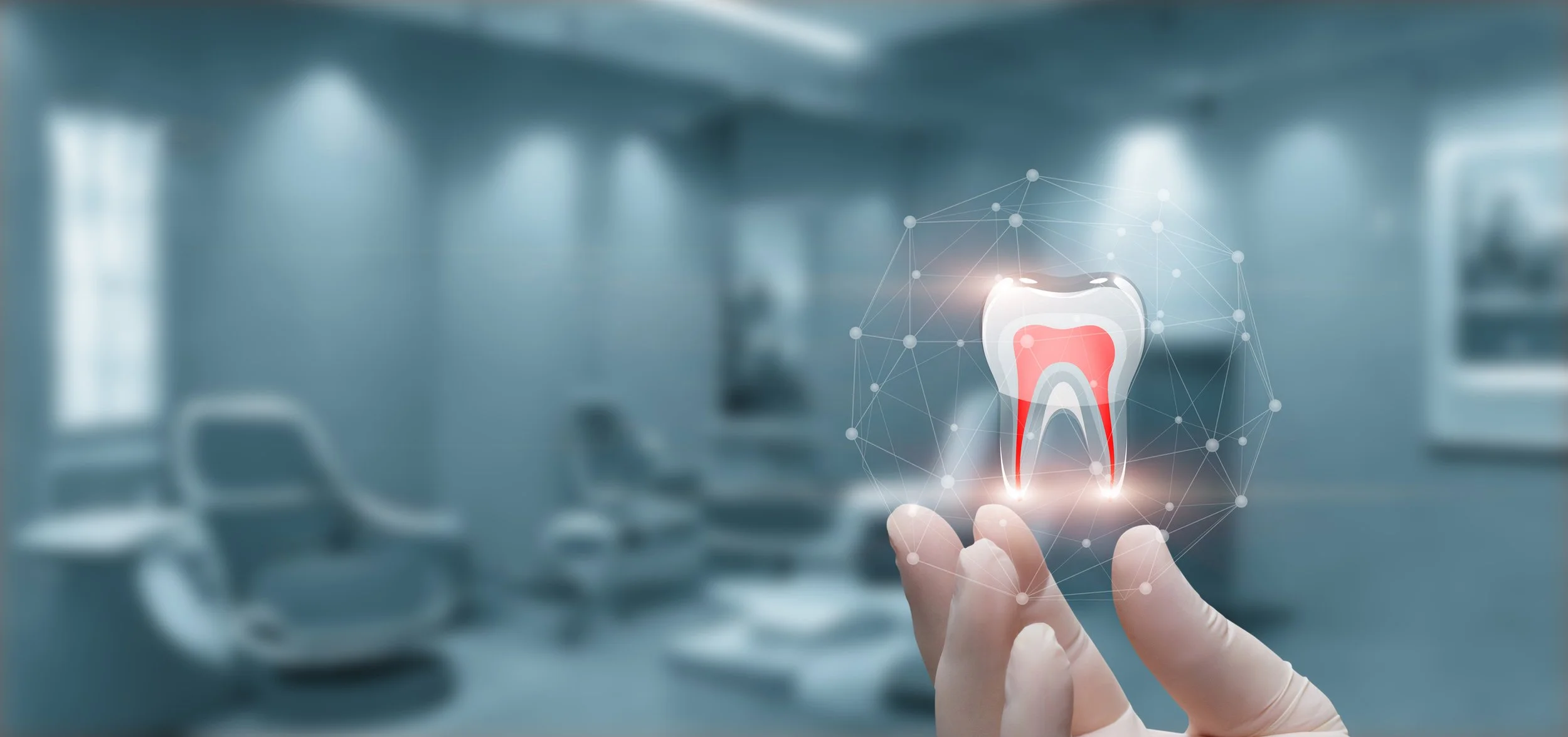
Tooth Preservation
What materials do Biomimetic dentists use?
Biomimetic dentists use flexible composite resins and woven fibers (like Ribbond) inside the tooth to copy the low modulus of flexible dentin.
For indirect restorations like inlays, onlays or a partial crown, they use glass-ceramics (like Emax) on the outside to copy the higher modulus of stiff enamel.
By matching the modulus of elasticity, the repaired tooth behaves as one single, happy unit. When you chew, the entire tooth flexes together, prevents cracks, and safely protects the living nerve inside!
Biomimetic dentists customize the treatment and materials according to your tooth’s needs.
Do I really need a crown?
Not every crown is the same. Biomimetic dentists take a minimally invasive approach that preserves as much sound, healthy tooth structure as possible. After removing decay, cracks, and other compromised areas, we restore only the structure that has been lost.
Conservative restoration options may include:
• Partial crowns or ¾ crowns
• Overlays
• Onlays
• Inlays
These indirect restorations replace tooth structure damaged by decay, cracks, or necrosis while helping preserve the healthy portions of the tooth.
What Is Biomimetic Dentistry?
Biomimetic means to mimic nature. The goal of biomimetic dentistry, also known as biomimetic restorative dentistry, is to conserve healthy tooth structure, prevent root canals and restore teeth that have decay or cracks to their natural strength.
Replicating the natural state of a tooth begins with removing decay and cracks while preserving healthy portions of a tooth.
The tooth is then sealed to protect the nerve, prevent symptoms like pain and sensitivity and preserve the long-term health of the tooth. This foundation is called the “biobase” and is what sets biomimetic dentistry apart from traditional practices.
Once sealed, composite materials are used that bond the tooth side to side, front to back and top to bottom, restoring the tooth’s natural flexibility and strength. Restoring a tooth in this way blocks bacteria from causing decay, prevents cracks and preserves the vitality of the tooth.
Biomimetic dentists use high magnification and research studies to aid with determining the causes of dental pathologies and help with their diagnosis.
Studies in biomimetic dentistry allow us to treat the causes of symptoms, rather than recommend invasive treatments.
Cracks are removed under high magnification to make sure the preserved tooth structure is sound. Decay is removed using Caries Detecting Dye, a solution that shows exactly which parts of the tooth are infected and should be removed. This is done while measuring to protect the tooth’s nerve because exposing a nerve can put it at risk for necrosis down the line.
The tooth is then sealed, creating what biomimetic dentists call the “biobase.” This foundation protects your tooth’s nerve against infection and cracks.
A fiber called Ribbond is often used inside your tooth to help strengthen the restoration, especially for weaker teeth like those that have undergone root canal therapy.
The tooth is rebuilt using advanced adhesive materials and techniques to prevent further decay and cracks. Biomimetic restorations have been shown to last over 20 years.
Traditional vs. Biomimetic Dentistry: What's the Difference?
Traditional dentistry focuses on replacing missing tooth structure with strong, rigid mechanical materials that rely on mechanical retention, often severely undermining healthy tooth structure and vital pulp tissue.
Biomimetic dentistry focuses on preserving natural tooth structure and utilizing advanced bonding and materials that match the flexibility, strength, biology and aesthetic properties of a real tooth.
The core difference lies in how each approach treats the healthy parts of your tooth: traditional methods often sacrifice healthy tissue to make a restoration fit. On the other hand, biomimetic methods use gold standard bonding protocols and materials backed by research and scientific evidence to save as much natural tooth as possible.
Structural Comparison
Traditional Dentistry
-
Mechanical Restoration: Uses strong, rigid materials to cap or plug the tooth.
-
Low Preservation: Drills away significant amounts of healthy enamel and dentin to anchor crowns or fillings.
-
Mechanical Retention: Relies on deep undercuts, parallel walls, or heavy cements to friction-hold a restoration.
-
Rigid & Unforgiving: Materials like gold, porcelain-fused-to-metal, silver amalgam, and Zirconia do not flex, which can crack the underlying tooth over time.
-
Higher Root Canal Risk: Aggressive drilling can shock, irritate, or expose the dental pulp (nerve), leading to root canals.
Biomimetic Dentistry
-
Life-Imitating: Copies nature's design to make the restored tooth function like a whole, healthy tooth.
-
High Preservation: Removes only damaged or decayed tissue, leaving 100% of healthy tooth structure intact.
-
Evidence-based Chemical Bonding: Fuses the material directly to the tooth at a microscopic level, mimicking natural structural layers.
-
Biomechanical Match: Composite resins polymerize and engineered ceramics flex as closely to natural teeth. Materials used are biocompatible. We replace like with like using materials that mimic your natural teeth.
-
Lower Root Canal Risk: Avoids unnecessary drilling and seals the pulp tightly, keeping the tooth alive and vital.
Why the Approaches Differ
In traditional dentistry, if you have a large cavity or a cracked tooth, a dentist will typically grind the tooth down into a small peg to fit a full-coverage crown (cap). While the crown itself is incredibly strong, the natural tooth underneath is heavily weakened. If bacteria slip under the cement, the tooth can decay unnoticed, often leading to a root canal or extraction.
In biomimetic dentistry, a dentist will selectively remove only the decay, crack and weakened structure. Instead of a crown, they rebuild the tooth layer-by-layer using advanced adhesive protocols. They use materials that mimic the flexibility of dentin (the inside of the tooth) and the hardness of enamel (the outside of the tooth). This distributes chewing forces naturally and seals out bacteria, significantly extending the lifespan of the tooth.
Traditional dentistry has long relied on an aggressive approach: grinding down a substantial amount of healthy tooth structure to make room for a full-coverage crown, or creating deep undercuts to anchor metal amalgam fillings. Biomimetic dentists argue this kicks off a downward spiral known as the "tooth cycle of death". Heavy drilling stresses the tooth, often leading to hidden micro-cracks, bacterial leakage, root canals, and eventual tooth loss.
Can a Cracked Tooth Be Saved?
Absolutely! We always start with your dental history. Unfortunately, some teeth become severely compromised due to the extent of the crack and cannot be saved. We review symptoms to check for possible nerve involvement. A tooth may need to be root canal treated due to nerve involvement but is still restorable using advanced bonding techniques, fiber reinforcement and indirect restorations that behave closely to your natural tooth.
Additionally, a tooth that is free of nerve involvement and nerve symptoms may be rebuilt and reinforced using fiber, adhesives, composites and if needed, a preservative partial crown that replaces lost structure.
Biomimetic treatment of cracks
Biomimetic means to mimic nature. In biomimetic dentistry, our aim is to mimic a natural tooth, which is free of gaps or cracks into dentin so a tooth restored biomimetically should also be free of gaps and cracks. Steps for crack removal include safe, predictable crack removal aided by high magnification and air abrasion. Once the crack is removed, the tooth is restored using bonding techniques that continue to mimic a natural tooth and bonding to the healthy tooth structure at the same strength at which a natural tooth is bonded to itself. This enables the tooth to resume natural function and be symptom-free.
What Is an EMAX Crown?
An E-max crown is a type of all-ceramic dental crown made from lithium disilicate glass-ceramic, a high-strength material known for its exceptional translucency, lifelike beauty, and durability. Some materials, like zirconia, are actually too hard. If a material is too stiff, it forces the weaker root underneath to absorb all the chewing stress, causing root fractures. Emax flexes similarly to real enamel, safely distributing pressure.
It is our material of choice because it can be bonded chemically rather than just cemented mechanically. This creates a tight seal all around the tooth preventing bacterial and acid assault.
This material allows us to prepare teeth conservatively and preserve healthy tooth structure in inlays, onlays, or partial crowns. We can design teeth and crowns conservatively to replace only the damaged part of a tooth. This avoids grinding the healthy portion of your tooth down into a peg for a traditional full-coverage crown.
What Is Ribbond and How Is It Used in Dentistry?
Ribbond is the most fracture tough dental fiber reinforcement available to the dental industry and also has the best manageability. Ribbond consists of combination of patented leno weave and flexible ultra-high molecular weight polyethylene fibers. It has unsurpassed fracture toughness, which is utilized to bridge cracks that are commonly seen in the pulpal floor of teeth that have had old amalgam restorations. The closely bonded Ribbond liner restores these teeth to the fracture resistance level of teeth that are free of such cracks. Additionally, it interrupts cracks and distributes stress. Additionally, biomimetic dentists use fiber reinforcement to line thin walls and fragile areas in root canal treated teeth therefore increasing their fracture resistance.
Why Does My Tooth Hurt After a Large Filling?
Traditional fillings are generally placed in bulk which leads to shrinkage when cured or set with the blue light. In large cavities, this shrinkage can pull the walls of your tooth inward, causing internal stress and micro-cracks. This will feel like persistent sensitivity to cold.
Another cause may be due to micro-leakage (gap at the bottom). When a traditional filling does not bond perfectly to the deep floor of the cavity, a tiny microscopic gap forms. Liquid gets trapped in this gap, and every time you chew, the liquid gets squeezed against the nerve.
Biomimetic dentists avoid this by placing fillings in tiny, stress-reduced layers and using fiber-reinforced liners to prevent the tooth from bending or cracking under the filling. Additionally, biomimetic dentists utilize gold standard adhesives tested and backed by research and studies that have proven their resistance to leaking and breakdown.
Can a Dentist Help Me Avoid a Root Canal?
When a Root Canal May Be Necessary
Root canal treatment cannot always be avoided when a tooth has been severely compromised by deep decay, cracks, or large restorations. These conditions can allow bacteria to reach the pulp, causing inflammation and, eventually, tissue death. Traditional treatment may recommend a root canal when decay approaches the tooth’s inner nerve.
How Biomimetic Dentistry May Help
Preserving the tooth’s vitality and reducing the need for root canal treatment are primary goals of biomimetic dentistry. Conservative preparation techniques help protect healthy tooth structure and the pulp, which contains the tooth’s nerves and blood vessels.
Protective Techniques
Air abrasion, caries-detecting dye, and high magnification allow the dentist to remove biofilm and affected dentin near the pulp with greater precision, reducing the risk of exposing vital tissue. Advanced multilayer bonding then creates a tight seal around the restoration, helping protect the pulp from acids, bacteria, and further breakdown.
Whether you can avoid a root canal depends entirely on the current health of your tooth's nerve.
Can Avoid a Root Canal
-
The decay is close to the nerve, but the nerve is still alive.
-
The tooth hurts from hot, cold, or sweets, but the pain stops quickly after the food or drink is gone.
-
A crack is causing sharp pain when biting down, but bacteria haven't infected the deep pulp yet.
Cannot Avoid a Root Canal (Too Late)
-
The nerve has completely died due to infection.
-
The tooth throbs constantly on its own, keeps you awake at night, or hurts for hours.
-
There is a visible pimple on your gums, facial swelling, or pus, meaning infection has spread to the bone.
Additional resources: